How to Owner-Train a Service Dog in Rhode Island: A Step-by-Step Plan
This page explains the law in general terms. It is not legal advice. For a specific situation, contact the agency listed on this site or an attorney.
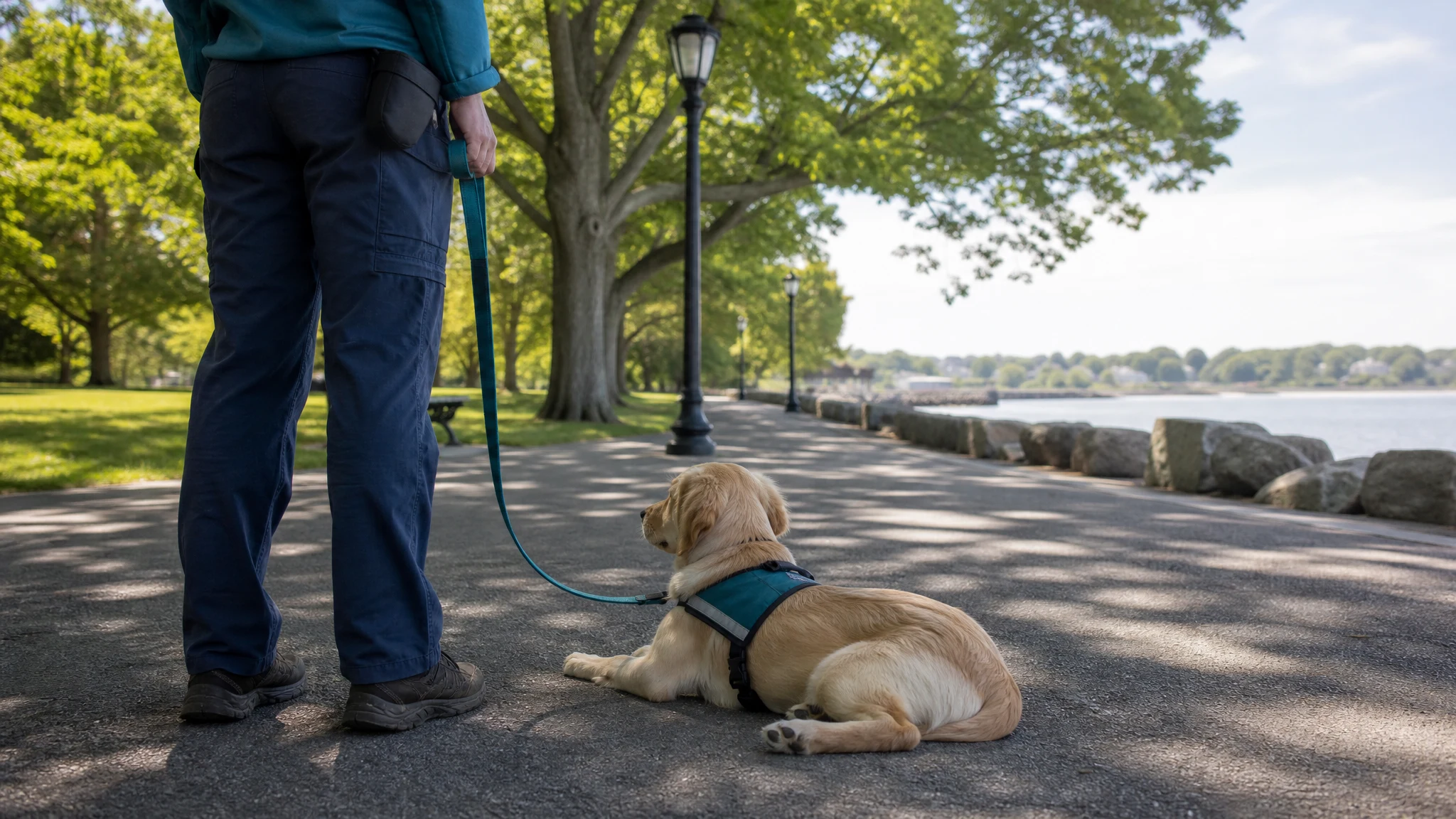
Many people with disabilities in Rhode Island choose to train their own service dog. It is allowed. Federal law does not require a program, and Rhode Island law speaks directly to dogs that are still in training.
This guide walks through the full path in five stages: screening, foundation obedience, socialization, task training and public access work. At each stage it ties the training to what Rhode Island law says. Owner training takes time and steady practice, and no plan can promise a particular result for a particular dog.
Key takeaways
- An owner trained service dog is legal. The ADA defines a service animal by what the dog has been trained to do, not by who did the training.
- Rhode Island law (R.I. Gen. Laws 40-9.1-2.1) gives a trainer or puppy raiser of a service animal the same public access rights as a person with a disability. The trainer is liable for any damage the dog does during training.
- No official ADA registry or certification exists, so there is nothing to register. Paying for an online certificate does not create legal status.
- Work in five stages: screen, build foundation skills, socialize, train disability-related tasks, then practice public access.
- Use reward-based methods only, in line with American Veterinary Society of Animal Behavior (AVSAB) guidance. Consider a professional trainer for task work.
- Falsely presenting a pet as a service animal in Rhode Island is a civil violation under R.I. Gen. Laws 40-9.1-3.1.
In this guide
- Is owner training legal in Rhode Island?
- Stage 1: Temperament and health screening
- Stage 2: Foundation obedience
- Stage 3: Socialization
- Stage 4: Task training
- Stage 5: Public access work
- Working with a professional trainer or program
- Housing, work and what to do if you are denied access
Is Owner Training Legal in Rhode Island?
Yes. The ADA.gov Service Animals FAQs say a service animal is a dog that has been individually trained to do work or perform tasks for a person with a disability. The definition looks at the dog's training and the disability. It does not require a particular school, and it does not require a certificate.
That is why the phrase owner trained service dog describes a fully recognized route. Many handlers choose it because they know their own needs best and want to shape the tasks themselves.
What Rhode Island adds
Rhode Island has its own statute, Chapter 40-9.1 of the General Laws. Four parts matter most to someone who plans to train their own dog.
- Definition. R.I. Gen. Laws 40-9.1-1.1 defines a service animal as a dog that has been, or is being, specifically trained to assist an individual with a disability. It includes guide dogs and hearing dogs. As written, it covers dogs only.
- Public access. Under R.I. Gen. Laws 40-9.1-2, a person with a disability may be accompanied by a service animal in the public places the chapter lists, including streets, buildings, transportation, schools, hotels, restaurants and theaters. No extra charge may be made. The handler is solely liable for damage the animal does.
- Dogs in training. R.I. Gen. Laws 40-9.1-2.1 says a trainer or puppy raiser of a service animal has the same rights and privileges as a person with a disability under section 40-9.1-2. The trainer is liable for any damage done during training.
- Misrepresentation. R.I. Gen. Laws 40-9.1-3.1 makes it a civil violation to expressly represent that a pet or other animal is a service animal to gain access to a public area, when the person knew or should have known the animal did not meet the definition. The penalty is up to 30 hours of community service for an organization serving people with disabilities.
The training-access provision, as the General Assembly's text reads, does not set age, harness or identification conditions, and it does not limit itself to professional trainers. If you need certainty about a specific situation, the Rhode Island Commission for Human Rights is the agency named in the chapter.
For a deeper look at these protections, see our page on service dogs in Rhode Island, training and access rights.
What does not exist
There is no official service dog registry under the ADA, and no required certification. Do not pay for a registration, ID card or certificate, and do not treat one as legal proof. I did not find a Rhode Island state ID program for service dogs in the sources for this guide. If you want to know whether one exists, ask the Commission for Human Rights.
Also keep the categories exact. Emotional support, therapy and comfort animals are not service animals under the ADA. A dog qualifies when it is trained to do work or tasks related to a person's disability. Comfort alone does not meet that test.
Stage 1: Temperament and Health Screening
Before any training begins, decide whether this dog can do the job. Many dogs are wonderful companions and still not suited to service work. Being honest at this stage protects you and the dog.
Temperament checks
Look for a dog that is steady, friendly without being pushy, and able to recover quickly from surprises. Watch how the dog handles:
- Sudden noises, such as dropped items or slamming doors
- Slippery floors and unfamiliar surfaces
- Strangers who reach out or crowd in
- Other dogs at a distance
- Handling of paws, ears, mouth and body
Fear, reactivity and strong guarding behavior are red flags. A dog that startles but recovers and then returns to you is a better sign than a dog that freezes or lunges.
Health checks
Service work asks a lot of a dog's body. A veterinarian you choose can assess joints, eyes, hearing, weight and general health, and advise on what your dog's size and structure can safely do. This matters most for mobility tasks such as bracing or pulling.
Choosing the dog
Some handlers begin with a puppy and some with an adult dog. A puppy lets you shape experiences from the start, but its adult temperament is uncertain. An adult dog shows more of its character, but may carry habits you must change. I did not find Rhode Island breed rules for service dogs in the sources for this guide, so ask the agency before assuming any restriction applies.
Rhode Island tie-in: The state definition covers a dog that is “being” trained, so your dog can have legal standing as a service animal in training from the start of the process. You, as trainer, are liable for damage during training, so choose a dog you can manage safely.
Stage 2: Foundation Obedience
Foundation skills are the base of everything else. If you want to know how to train a service dog, start here. Task work grows out of these habits.
The core skills
- Name response and eye contact. The dog checks in with you on its own.
- Sit, down and stand on cue, held until released.
- Loose-leash walking without pulling, in a heel or relaxed position.
- Recall. The dog comes when called, even with distractions.
- Stay and wait at doors, curbs and car exits.
- Leave it for food, dropped items and other dogs.
- Settle. The dog lies quietly under a table or beside a chair for long periods.
Reward-based methods only
Teach with treats, toys, praise and access to things the dog wants. Mark the right behavior, reward it, and make the next step small enough to succeed. This matches the position of the American Veterinary Society of Animal Behavior (AVSAB), which supports reward-based training.
Do not use shock, prong or choke collars. Do not use alpha rolls, scruffing or dominance methods. They add fear and stress, and a frightened dog is a poor candidate for public work.
How to practice
Keep sessions short and end on a success. A few brief sessions a day usually work better than one long one. Practice in a quiet room first, then add distractions slowly: the yard, a driveway, a quiet street.
Rhode Island tie-in: Under R.I. Gen. Laws 40-9.1-2.1, you as trainer carry liability for damage during training. Reliable recall, stay and leave it are your best protection. Use a secure leash whenever you are out, whatever the law allows.
Stage 3: Socialization
Socialization means teaching the dog that the world is safe and uninteresting. The goal is not for the dog to greet everyone. A service dog works best when it ignores most people and most dogs.
Build exposure in layers
- Surfaces and sounds. Tile, grates, stairs, elevators, car engines, sirens, carts.
- People. Hats, uniforms, wheelchairs, canes, children, crowds.
- Places. Quiet shops first, then busier ones, then restaurants and transit, as the dog shows it is ready.
- Other animals. Controlled, distant exposure, rewarding calm attention to you.
Watch the dog's body language. Yawning, lip licking, turning away or a tucked tail all say the dog is stressed. Increase distance and try again later. Never flood a dog with more than it can handle.
Where to socialize in Rhode Island
Use the places that are open to the public and fit your own life: streets, stores, buses, medical offices and campuses you already use. The state statute lists streets, buildings, transportation, schools, hotels, restaurants and theaters among the covered places. For any specific venue, call ahead if you are unsure, and be ready to explain the dog is in training.
Rhode Island tie-in: R.I. Gen. Laws 40-9.1-2.1 gives a trainer or puppy raiser the same rights as a person with a disability, which is what makes in-public socialization lawful for a dog in training. Business owners may still question a dog that is out of control, so a dog that is not yet ready should wait at home.
Stage 4: Task Training
Tasks are what separate a service dog from a pet or a comfort animal. The ADA.gov FAQs define a service animal as a dog individually trained to do work or perform tasks for a person with a disability. The tasks must relate to your disability.
Choose tasks that match your needs
The tasks depend on the handler. Examples drawn from the kinds of work service dogs do include:
- Retrieving dropped items or opening and closing doors
- Providing bracing or balance support
- Alerting to sounds for a person who is deaf or hard of hearing
- Interrupting or responding to behaviors linked to a psychiatric condition
- Alerting a handler, or getting help, during a medical event
Write down each task, the cue or trigger for it, and the behavior you expect. This record helps you train consistently. It also helps you answer questions about your dog clearly.
How to teach a task
- Break it into small steps. A retrieve becomes: look at the item, touch it, mouth it, pick it up, hold it, deliver it to your hand.
- Reward each step and add the next only when the first is solid.
- Add a cue once the behavior is reliable.
- Generalize. Practice in different rooms, with different items, at different times of day.
- Test under distraction before you rely on the task in public.
Be careful with safety-critical tasks
Tasks tied to medical alerts, psychiatric response or heavy bracing carry real risk if they are taught badly. A dog that fails to respond, or a brace that injures the dog or the handler, can cause harm. This is the stage where I recommend professional help most strongly.
Rhode Island tie-in: The state definition covers a dog “specifically trained to assist” a person with a disability. Real task training is what ties your dog to that definition. Comfort and companionship alone do not make a dog a service animal under the ADA.
Stage 5: Public Access Work
Public access work is where foundation skills, socialization and tasks come together. The dog must be calm, clean, under control and focused on you in places full of distractions.
What good public behavior looks like
- The dog walks beside you without pulling or sniffing displays.
- The dog settles under a table or at your feet and stays quiet.
- The dog ignores food, other dogs and people who try to interact.
- The dog is housebroken and relieves itself only on your cue and in a suitable place.
- The dog performs its tasks when needed.
Build up slowly. Start with a short trip to a quiet store, then lengthen visits and add busier places. If your dog struggles, go back a step. Pushing a dog past its limit risks setbacks that are slow to repair.
Answering staff questions
The ADA.gov FAQs say that when the need for the dog is not obvious, staff may ask two questions: is the dog a service animal required because of a disability, and what work or task has the dog been trained to perform? Staff generally may not ask for documentation or require a demonstration. Prepare a short, calm answer to the second question so you are not caught off guard.
Equipment and identification
A vest or harness is a personal choice. The statute text I reviewed does not require one, and the ADA does not either. Some handlers find a vest reduces questions from the public. If you use one, make sure it describes your dog truthfully. Do not buy an ID card or certificate as if it were proof, because none is required and none carries legal weight.
Be honest about readiness
R.I. Gen. Laws 40-9.1-3.1 makes it a civil violation to expressly represent a pet or other animal as a service animal to gain access when you knew or should have known it did not meet the definition. A dog that is not trained to do work or tasks does not meet it. A dog in training, though, falls within the definition and the trainer provisions discussed above.
Rhode Island tie-in: Under R.I. Gen. Laws 40-9.1-2, the handler is solely liable for damage the animal does, and under 40-9.1-2.1 the trainer is liable during training. Public access work is where that liability becomes real, so move at the dog's pace.
Working With a Professional Trainer or Program
Owner training does not mean doing it all alone. Many owner trainers hire a professional for the hardest parts, especially task training. A trainer can spot problems early, coach your handling and help with safety-critical tasks.
What to look for
- Reward-based methods only, with no shock, prong or choke tools and no dominance language
- Experience with service dog tasks, not only pet obedience
- Willingness to explain their methods and let you watch
- Clear costs and terms in writing
Ask directly how they handle a dog that is fearful or struggling. A good answer involves changing the plan, not adding pressure.
Rhode Island organizations to know about
These organizations appear in public sources. I have not reviewed their work, and their fees and waitlists were not available to me, so contact each directly.
- NEADS World Class Service Dogs is a nonprofit with a Princeton, Massachusetts mailing address. It recruits puppy raisers in Rhode Island and serves people with hearing loss, veterans, people with mobility needs and people with autism.
- NEADS Prison Pup Partnership Program operates at the Rhode Island Department of Corrections in Cranston, according to a state press release.
- Little Rhody Rescue in Glocester, RI lists The Sirius Project, with Dog On It, as a service dog effort.
- Dog Training Elite, serving Providence, RI and New Bedford, MA, lists service dog training on its site.
For veterans, the state release on NEADS Canines for Combat Veterans describes a program with the Rhode Island Department of Corrections that began in October 2006. K9s For Warriors is a national nonprofit, not based in Rhode Island, that provides service dogs to veterans with PTSD, traumatic brain injury or military sexual trauma. Confirm eligibility with each group.
Housing, Work and What to Do if You Are Denied Access
Housing
R.I. Gen. Laws 34-37-4(e) says a person with a disability who has a guide dog or other personal assistive animal has full and equal access to covered housing. No extra compensation may be required for the animal, and the tenant is liable for damage to the premises. The section also requires reasonable accommodations in rules and policies.
One detail deserves care. That statute defines a personal assistive animal as one trained by a certified animal training program for independent living tasks. If you are an owner trainer, ask the Commission for Human Rights how this wording applies to you. Federal housing rules, administered by HUD, may also apply, so check with that agency as well.
Employment
R.I. Gen. Laws 28-5-7 prohibits disability discrimination in employment and requires reasonable accommodation unless it would cause hardship. It does not mention service animals specifically. If you want to bring a dog to work, put the request in writing, explain the tasks, and ask the Commission for Human Rights if you meet resistance.
If you are denied access
Stay calm and polite. Answer the two permitted questions. If the business still refuses, leave, write down the date, place and what was said, and consider a complaint.
R.I. Gen. Laws 40-9.1-4 empowers the Rhode Island Commission for Human Rights to enforce the chapter on its own initiative or on complaint. Its site is richr.ri.gov, and the number listed for it is (401) 222-2661. Confirm the number on the site before calling. This guide states the law as written and is not legal advice.
A simple checklist
- Screen the dog's temperament and health.
- Build foundation skills with reward-based methods.
- Socialize in layers, at the dog's pace.
- Train and document tasks tied to your disability, with a professional for safety-critical work.
- Practice public access in small steps, and be honest about readiness.
- Know your rights, and know where to file a complaint.
Owner training is slow, and some dogs will not make it. Retiring a dog from service work and keeping it as a pet is a good outcome, not a failure. Whatever happens, keep the dog's welfare ahead of the deadline.
Sources
- ADA.gov Service Animals FAQs
- Rhode Island General Assembly, Title 40 Chapter 40-9.1 index
- R.I. Gen. Laws 40-9.1-1.1
- R.I. Gen. Laws 40-9.1-2
- R.I. Gen. Laws 40-9.1-2.1
- R.I. Gen. Laws 40-9.1-3.1
- R.I. Gen. Laws 40-9.1-4
- R.I. Gen. Laws 34-37-4
- R.I. Gen. Laws 28-5-7
- Rhode Island Commission for Human Rights
- NEADS World Class Service Dogs
- State of Rhode Island press release on the NEADS Prison Pup Partnership Program
- State of Rhode Island press release on NEADS Canines for Combat Veterans
- K9s For Warriors