Service Dog Tasks and the Public Access Test, Explained
This page explains the law in general terms. It is not legal advice. For a specific situation, contact the agency listed on this site or an attorney.
Two ideas come up again and again when people train a service dog in Rhode Island. The first is the task: the specific job the dog does because of a disability. The second is the public access test, a way to check that a dog behaves well in public.
They are often mixed up. A task is what the law looks at. The public access test is a training benchmark. This guide explains both and walks through how to train and check each one using humane, reward-based methods.
What counts as a service dog task
ADA.gov says a service animal is a dog that has been individually trained to do work or perform tasks for an individual with a disability. Two parts of that sentence matter most: "individually trained" and "work or tasks."
The task has to be directly related to the person's disability. The dog does something the handler cannot do, or cannot do easily, because of that disability. It can be a physical action, an alert, or a response to a specific cue or situation.
Rhode Island's statute is similar. R.I. Gen. Laws 40-9.1-1.1 defines a service animal as a dog that has been, or is being, specifically trained to assist an individual with a disability. The definition includes guide dogs and hearing dogs.
What tasks can a service dog do?
The list is open-ended, because disabilities and needs vary so much. The examples below show the kind of work that is commonly described as a task. They are illustrations, not a legal checklist, and a dog does not have to do any particular one of them.
Mobility disabilities
- Retrieving dropped items, such as keys or a phone
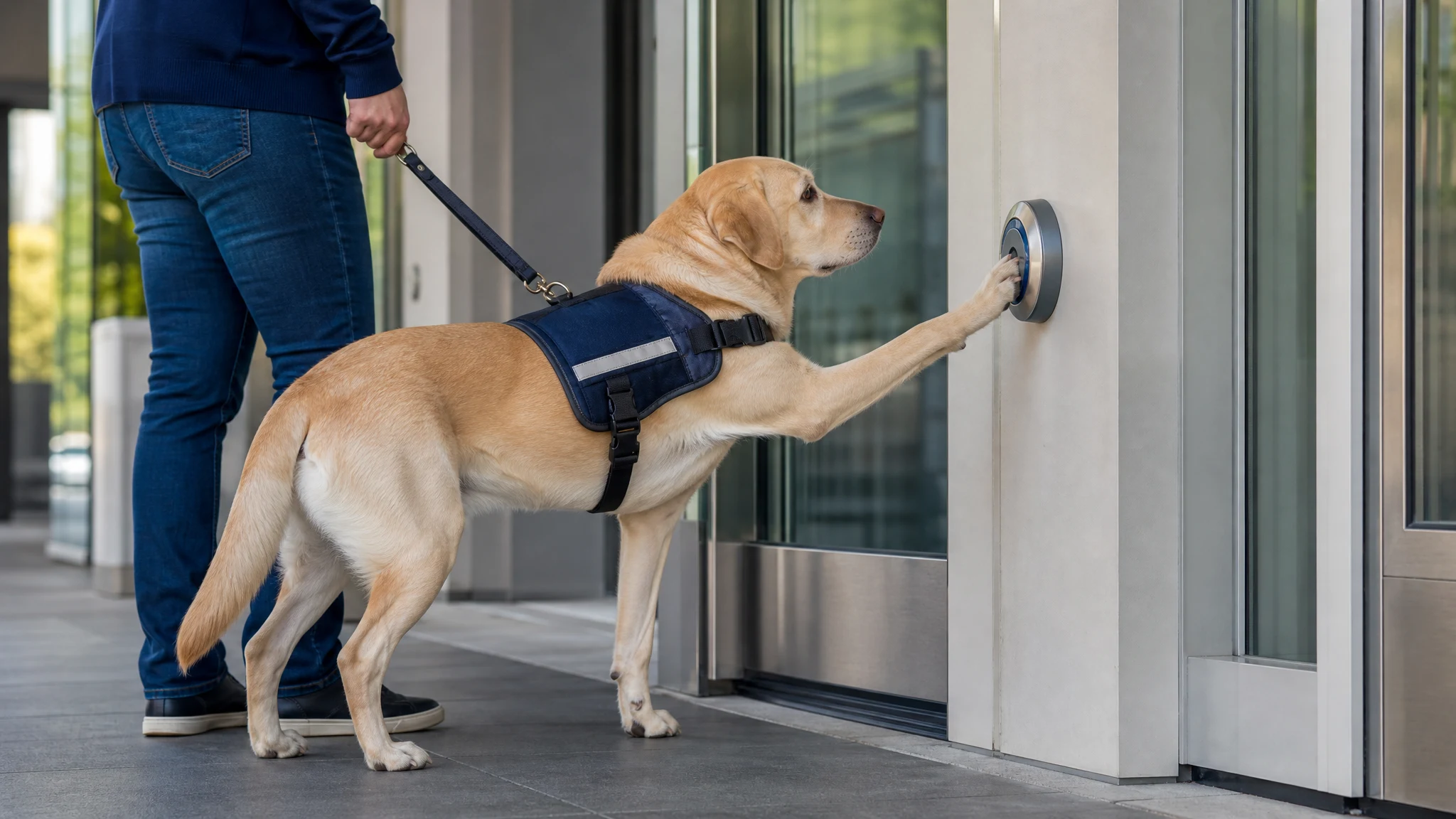
- Opening and closing doors or drawers
- Providing counterbalance or bracing when the handler stands up
- Pulling a manual wheelchair, if the dog is trained and fitted for it
Hearing disabilities
- Alerting the handler to a doorbell, alarm or approaching person
- Leading the handler to the source of a sound
Vision disabilities
- Guiding around obstacles
- Stopping at curbs and changes in elevation
- Finding doors, stairs or an open seat
Medical conditions
- Alerting to a change linked to a medical event, if the dog has been trained to do so
- Fetching medication or a phone during a medical event
- Staying with the handler and getting help, if the dog has been trained for that
Psychiatric and neurological disabilities
- Interrupting a harmful repetitive behavior with a trained cue
- Turning on lights or checking a room for a handler with PTSD, when trained to do so
- Creating a trained buffer in a crowd, for example by standing behind or beside the handler
- Waking the handler from a nightmare with a trained response
Autism
- Interrupting self-injury or a trained pattern of distress
- Helping keep a child from bolting, when the dog is trained and the setup is safe
Some programs and trainers in and around Rhode Island work in these areas. NEADS World Class Service Dogs recruits puppy raisers in the state. Little Rhody Rescue in Glocester and Dog Training Elite in Providence also describe work with service dogs. Fees and waitlists were not available, so check with each organization directly.
Why comfort alone is not a task
Many dogs make their owners feel better, and that matters. Under the ADA, though, emotional support, therapy and comfort animals are not service animals. A dog's presence, calming effect or companionship is not work or a task.
The line is about training. A dog that is trained to do something specific in response to a symptom or need is doing a task. Examples are pressing against the handler to interrupt a panic episode on cue, or fetching medication. A dog that simply makes the handler feel calm by being nearby is not doing a task under the ADA.
Rhode Island treats false claims seriously. Under R.I. Gen. Laws 40-9.1-3.1, it is a civil violation to expressly represent that a pet or other animal is a service animal to gain access to a public area, when the person knew or should have known the animal did not meet the definition. The penalty is up to 30 hours of community service for an organization serving people with disabilities.
The service dog public access test, explained
A public access test checks how a dog behaves in stores, restaurants, offices and other busy places. Assistance Dogs International (ADI) is the group most often tied to the standard. Many programs and handlers use an ADI-style test as a benchmark.
Here is the key point: the ADA does not require a service dog to pass a public access test. It also does not require certification, a registry listing or an ID card. The test is a training tool. It helps you judge whether a dog is ready for public work, and it helps you spot the skills that still need practice.
The ADA does expect a dog to be under the handler's control. A dog that passes a well-run test is more likely to meet that expectation. Check with ADI directly for its current test items and scoring, since this article does not reproduce them.
How to train tasks and prepare for a public access test
Materials you will need
- A well-fitted flat collar or harness (never a shock, prong or choke collar)
- A standard six-foot leash
- Small, soft treats your dog loves, plus a treat pouch
- A clicker or a consistent marker word such as "yes"
- A mat or small blanket for settling practice
- Objects for task practice, such as keys, a pill bottle or a rope pull on a door
- A notebook or phone to log sessions and note progress
- A helper, such as a friend or family member, for distraction practice
Step 1: Name the task and tie it to the disability
Write down what the dog will do and why. For example: "Retrieves dropped items because I cannot bend to pick them up." If you cannot connect the behavior to a disability-related need, it may be a nice habit but not a task.
Break the task into small pieces. Retrieving, for example, includes noticing the item, picking it up, bringing it back and releasing it into a hand.
Step 2: Build a foundation of calm, basic skills
Before any task, make sure the dog can sit, down, stay, come when called and walk on a loose leash. Reward each skill with food, play or praise. Keep sessions short, about five minutes, and end while the dog is still keen.
Reward-based training is what the American Veterinary Society of Animal Behavior (AVSAB) recommends. It builds a dog that is willing to work, not one working out of fear.
Step 3: Teach each task in small, rewarded steps
Mark and reward the first tiny step, such as looking at the object. Then ask for a little more: a nose touch, then a mouth touch, then a pick-up, then a carry. Raise the bar only when the dog is succeeding most of the time.
Add a cue, either a word or a signal, once the behavior is reliable. For alert tasks, teach the dog to respond to the trigger itself, and have a helper present it safely and in a controlled way.
Step 4: Practice in new places
Dogs do not automatically carry a skill from the living room to a store. Practice each task in a new room, then the yard, then a quiet public space, then busier ones. Lower your expectations a little in each new place and rebuild.
Step 5: Add public manners
Public manners are what a public access test measures. Work on these one at a time:
- Walking calmly on a loose leash past people, carts and other dogs
- Ignoring dropped food and strangers who try to pet or call the dog
- Settling under a table or beside a seat without wandering
- Staying calm around doors, elevators and tight spaces
- Not barking, lunging, sniffing merchandise or soliciting attention
- Staying in control when the handler leaves briefly or when a distraction appears
Reward calm choices often. A dog that is paid for ignoring distractions learns that ignoring them is worth the effort.
Step 6: Run a practice public access test
Once the dog is steady in everyday outings, ask a helper to watch you work through a full outing, from entering a building to leaving it. Use ADI's current test items as your guide. Note anything that went wrong and train that skill before you try again.
A dog does not need to be perfect on the first run. The point is to see what is solid and what needs work.
Step 7: Keep the skills fresh
Public behavior and task work fade without practice. Keep rewarding good work, repeat short refreshers and check in on health and comfort. If a dog seems stressed, tired or sore, pause the work and have a veterinarian check it.
Tips for success
- Train the task, not just the trick. Make sure every task has a clear link to the disability.
- Keep sessions short and positive. Five good minutes beat thirty frustrating ones.
- Raise criteria slowly. Add one new challenge at a time: distance, duration or distraction.
- Plan breaks. A tired dog makes more mistakes, and a stressed dog may not be ready for public work.
- Log your progress. Notes help you see what is improving and when to slow down.
- Know the two questions. ADA.gov says that when the need is not obvious, staff may ask whether the dog is a service animal required because of a disability, and what work or task it has been trained to perform. Practice a calm, short answer.
Common mistakes to avoid
- Treating comfort as a task. Being calming is not a trained task under the ADA.
- Buying a registration or certificate. The ADA has no official registry or required certification, and an online registration is not legal proof of anything.
- Treating the public access test as a legal requirement. It is a benchmark, not an ADA rule.
- Skipping gradual exposure. Jumping straight into a crowded store can set training back.
- Using harsh tools or corrections. Shock, prong and choke collars, alpha rolls and scruffing are not part of humane training. They can damage trust and make behavior worse.
- Ignoring the dog's stress signals. Yawning, lip licking, avoiding eye contact or freezing can mean the dog needs a break.
What to expect
Training a task and building public manners usually takes months of steady practice, and often longer. The time varies with the dog's age, temperament and the complexity of the task. Many handlers find progress comes in steps, with some plateaus.
With consistent, reward-based practice, a dog may become more reliable at its tasks and calmer in public. Results differ from dog to dog, and no outcome is certain. If you are stuck, a qualified trainer who uses reward-based methods may be able to help.
Rhode Island rights, training and complaints
Under R.I. Gen. Laws 40-9.1-2, a person with a disability may be accompanied by a service animal in places open to the public, with no extra charge. The handler is solely liable for damage the animal does.
R.I. Gen. Laws 40-9.1-2.1 gives trainers and puppy raisers of service animals the same rights and privileges, along with liability for damage during training. For a fuller look at how access works while a dog is in training, see our guide to service dogs in Rhode Island, training and access rights.
If you believe access has been wrongly denied, R.I. Gen. Laws 40-9.1-4 empowers the Rhode Island Commission for Human Rights to enforce the chapter on its own initiative or on complaint. Its website is richr.ri.gov, and the number listed there is (401) 222-2661. Confirm contact details with the agency before you call. This is general information, not legal advice.
Sources
- ADA.gov Service Animals FAQs
- R.I. Gen. Laws 40-9.1-1.1, RI General Assembly
- R.I. Gen. Laws 40-9.1-2, RI General Assembly
- R.I. Gen. Laws 40-9.1-2.1, RI General Assembly
- R.I. Gen. Laws 40-9.1-3.1, RI General Assembly
- R.I. Gen. Laws 40-9.1-4, RI General Assembly
- Rhode Island Commission for Human Rights